Reduce matrix interference
Separate microorganisms from blood cells, proteins, cellular debris and other components that could obscure or distort the analytical signal.

Science
Antimicrobial susceptibility testing traditionally relies on observing whether microorganisms grow in the presence of an antibiotic.
FASTINOV's research began with a different question:
Could antimicrobial susceptibility be detected from the early response of individual microbial cells, before conventional growth becomes visible?
Flow cytometry offered a way to investigate that question.
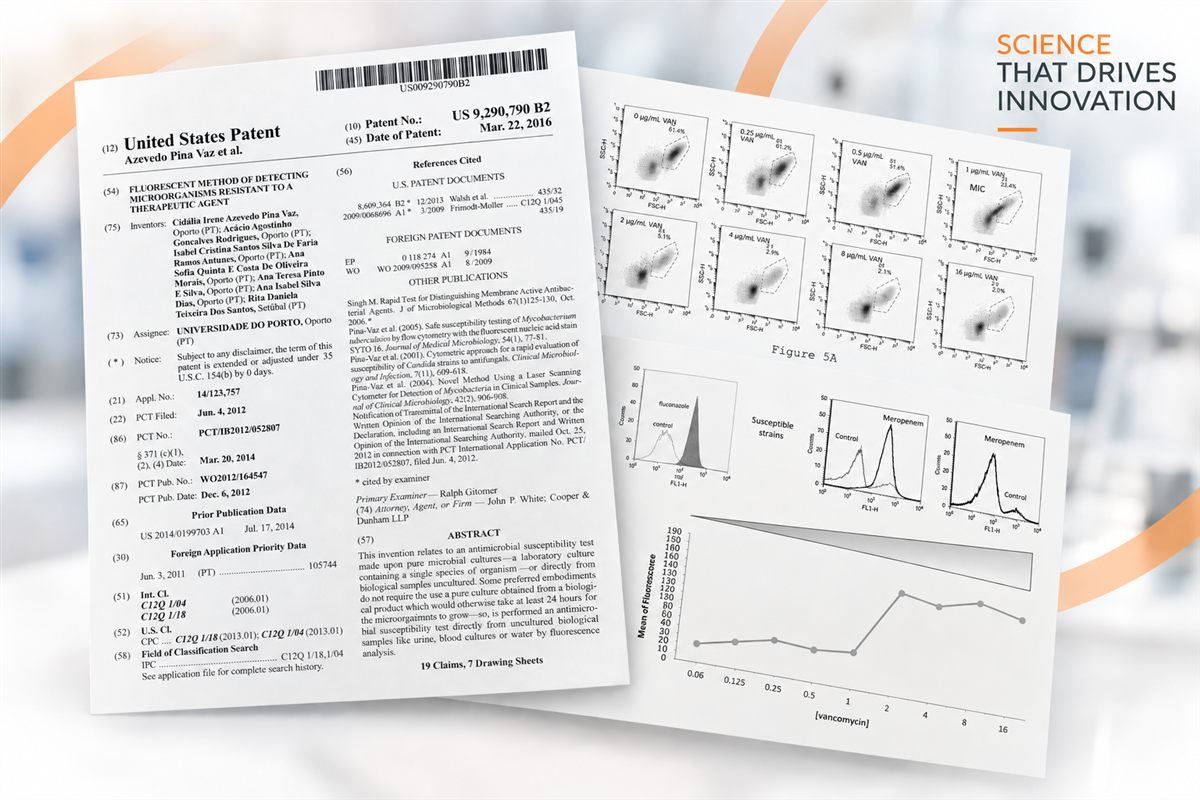
01 Flow cytometry
Antimicrobials begin affecting susceptible microorganisms before those effects become visible as changes in population growth.
FASTINOV developed methods combining fluorescent probes with flow cytometry to detect early cellular and metabolic changes following antimicrobial exposure. Proprietary analytical algorithms interpret the resulting cytometric information and classify the microbial response according to its susceptibility phenotype.
The objective was to preserve the fundamental principle of phenotypic AST — observing how the microorganism actually responds to an antimicrobial — while obtaining that information much earlier.
FASTINOV's research led to ultra-rapid phenotypic AST workflows capable of producing susceptibility results directly from positive blood cultures in less than two hours.
02 Direct testing
Performing flow cytometry directly from clinical samples created another scientific challenge.
A positive blood culture is not a suspension of microorganisms alone. It also contains blood cells, proteins, cellular debris and other components of the original sample matrix. These components can generate background signals, artefacts and interference during flow-cytometry analysis.
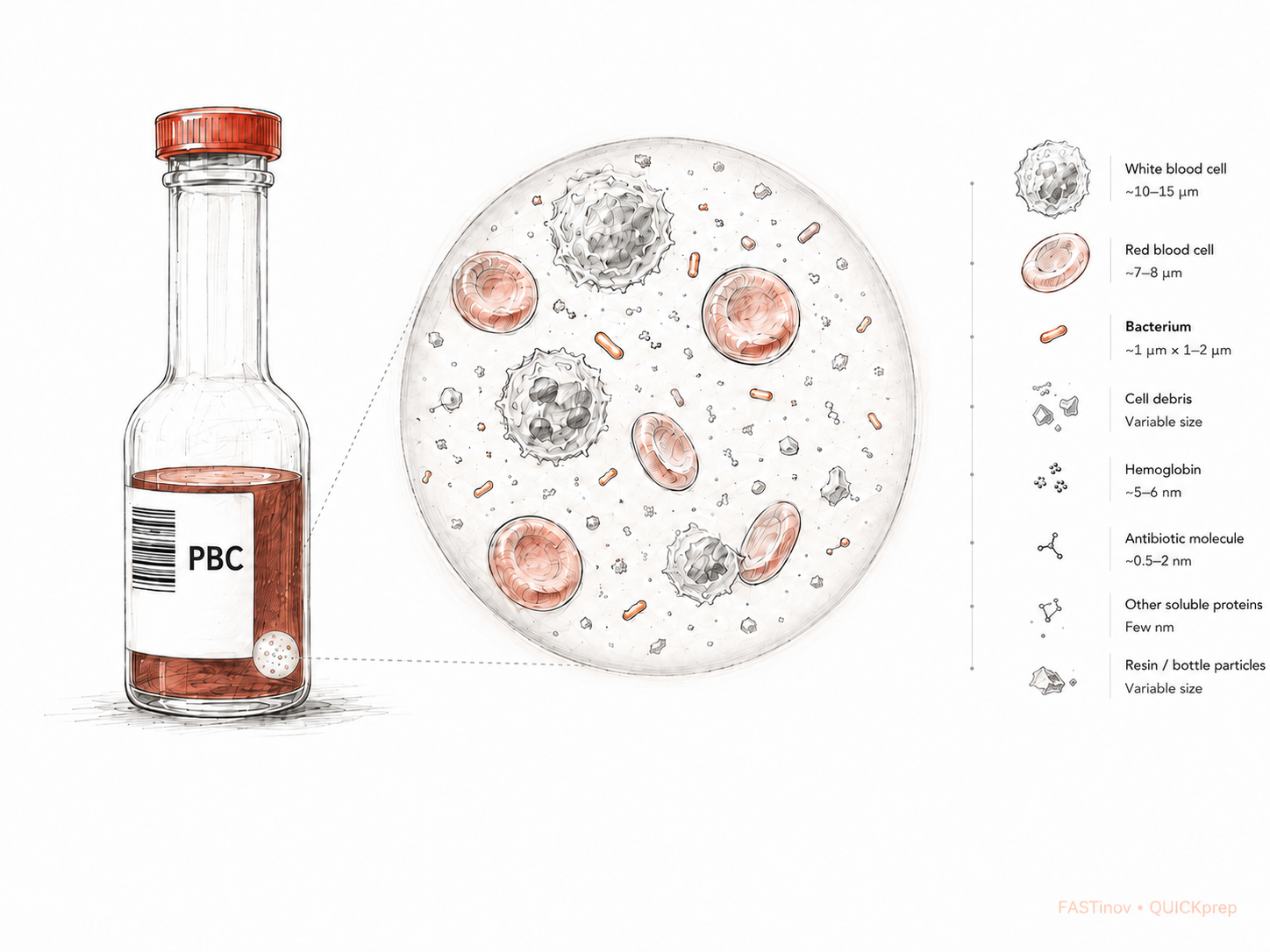
The preparation could not simply remove material from the sample. FASTINOV needed to recover microorganisms at sufficient concentration while preserving their viability and biological response to antimicrobial exposure.
Separate microorganisms from blood cells, proteins, cellular debris and other components that could obscure or distort the analytical signal.
Recover viable microorganisms capable of producing measurable biological responses during phenotypic antimicrobial susceptibility testing.
A visually clean sample alone was not sufficient. The microorganisms also had to remain functionally intact.
03 Sample preparation
FASTINOV developed a proprietary sample-preparation approach designed to reduce interference from the original sample matrix while recovering a concentrated pellet of viable bacteria or yeasts.
The recovered microorganisms can then be resuspended and adjusted to the concentration required for downstream analysis. For FASTINOV's flow-cytometry AST workflow, this provided the clean and biologically active microbial suspension required for rapid phenotypic testing.
The original application was positive blood culture preparation for ultra-rapid phenotypic AST, but later the company validated the method on other samples.
04 QUICKprep
FASTINOV's sample-preparation approach was originally developed because ultra-rapid AST required a reliable way to obtain clean, viable microorganisms directly from clinical samples.
But the resulting preparation was not inherently limited to flow cytometry. Once microorganisms have been separated from interfering sample components and recovered in a concentrated, viable form, they can be used in other downstream microbiology workflows.
FASTINOV subsequently evaluated the approach for direct identification by MALDI-TOF mass spectrometry and expanded its use to additional sample types, including urine. This technology became the scientific and technical foundation of QUICKprep.
Flow cytometry detects early cellular effects following antibiotic exposure.
Direct analysis requires reduction of sample-matrix interference while preserving viable microorganisms.
The proprietary preparation technology becomes a dedicated platform for downstream microbiology workflows.
FASTINOV's flow-cytometry research and QUICKprep are consecutive parts of the same scientific development path.
Evidence
Multicentre evaluation of FASTINOV ultra-rapid flow-cytometry AST directly from positive blood cultures.
<2 h ASTRead study →Three-site clinical validation using inoculated and clinical positive blood cultures.
>97% overall categorical agreement · <2 h ASTRead study →FASTINOV's preparation approach has supported direct MALDI-TOF identification and has been developed into QUICKprep.
Explore QUICKprep evidence →Research & IP
FASTINOV's scientific work spans microbial physiology, fluorescence-based analysis, flow cytometry, antimicrobial susceptibility testing, antimicrobial-resistance detection, sample preparation and rapid microorganism identification.
This research has generated an international intellectual-property portfolio and a growing body of scientific evidence involving FASTINOV technologies and products.
Publications
Silva-Dias A, Pérez-Viso B, Martins-Oliveira I, et al. Journal of Clinical Microbiology. 2021;59(10):e00544-21.
Read publication →Pina-Vaz C, Silva-Dias A, Martins-Oliveira I, et al. BMC Microbiology. 2024;24:187.
Read publication →Sousa-Pinheiro M, Martins-Oliveira I, Abreu D, et al. Microorganisms. 2026;14(3):711.
Read publication →Cruz S, Abreu D, Gomes R, et al. European Journal of Clinical Microbiology & Infectious Diseases. 2024;43:605–610.
Read publication →Sousa-Pinheiro M, Martins-Oliveira I, Abreu D, et al. European Journal of Clinical Microbiology & Infectious Diseases. 2026.
Read publication →FASTINOV's research began with the challenge of detecting antimicrobial susceptibility earlier. Solving that challenge required new approaches not only to analysis, but also to the preparation of microorganisms directly from clinical samples.
