Treat the original sample
The technician adds the QUICKprep reagents according to the Instructions for Use.

QUICKprep is a manual sample-preparation kit designed to separate bacteria and yeasts from human cells, proteins, debris and other sample components.
Using QUICKprep, the technician recovers a microorganism pellet that can be resuspended and adjusted to the concentration required for the intended downstream method.
Recovery of viable, culturable microorganisms is demonstrated by growth after subculture.
Why sample preparation matters
FASTINOV research in rapid flow-cytometry antimicrobial susceptibility testing demonstrated the importance of preparing a microorganism suspension with sufficient density and reduced interference from the original sample matrix. This requirement contributed to the development of QUICKprep.
The technician adds the QUICKprep reagents according to the Instructions for Use.
The prescribed reagent treatments and processing steps help separate microorganisms from human cells, proteins, cellular debris and other components of the original sample.
After processing, the technician recovers a pellet containing bacteria or yeasts for resuspension.
The recovered microorganisms can be resuspended and adjusted to a standardized 0.5 McFarland suspension, according to the requirements of the intended downstream method.
FASTINOV research and proprietary technology
FASTINOV developed rapid flow-cytometry methods for antimicrobial susceptibility testing. Those methods require a clear, consistent inoculum so that microorganism responses can be measured quickly and reliably.
QUICKprep was developed to address that upstream preparation challenge: help separate microorganisms from the sample matrix, support recovery of viable, culturable bacteria and yeasts, and provide a defined starting material for the intended downstream method.
Patents and proprietary researchThe technology underlying QUICKprep is supported by FASTINOV's proprietary research and international patent portfolio.
How the technology performs, and what the published data show.
Primary product performance
The primary endpoint evaluates the preparation obtained by a technician using QUICKprep - not the result of a downstream identification or antimicrobial susceptibility test.
84/84 evaluated preparations met both predefined success criteria.
Sufficient microbial material to prepare a standardized 0.5 McFarland suspension.
McFarland measures suspension turbidity and does not, by itself, demonstrate microorganism viability.Confirms recovery of viable, culturable microorganisms.
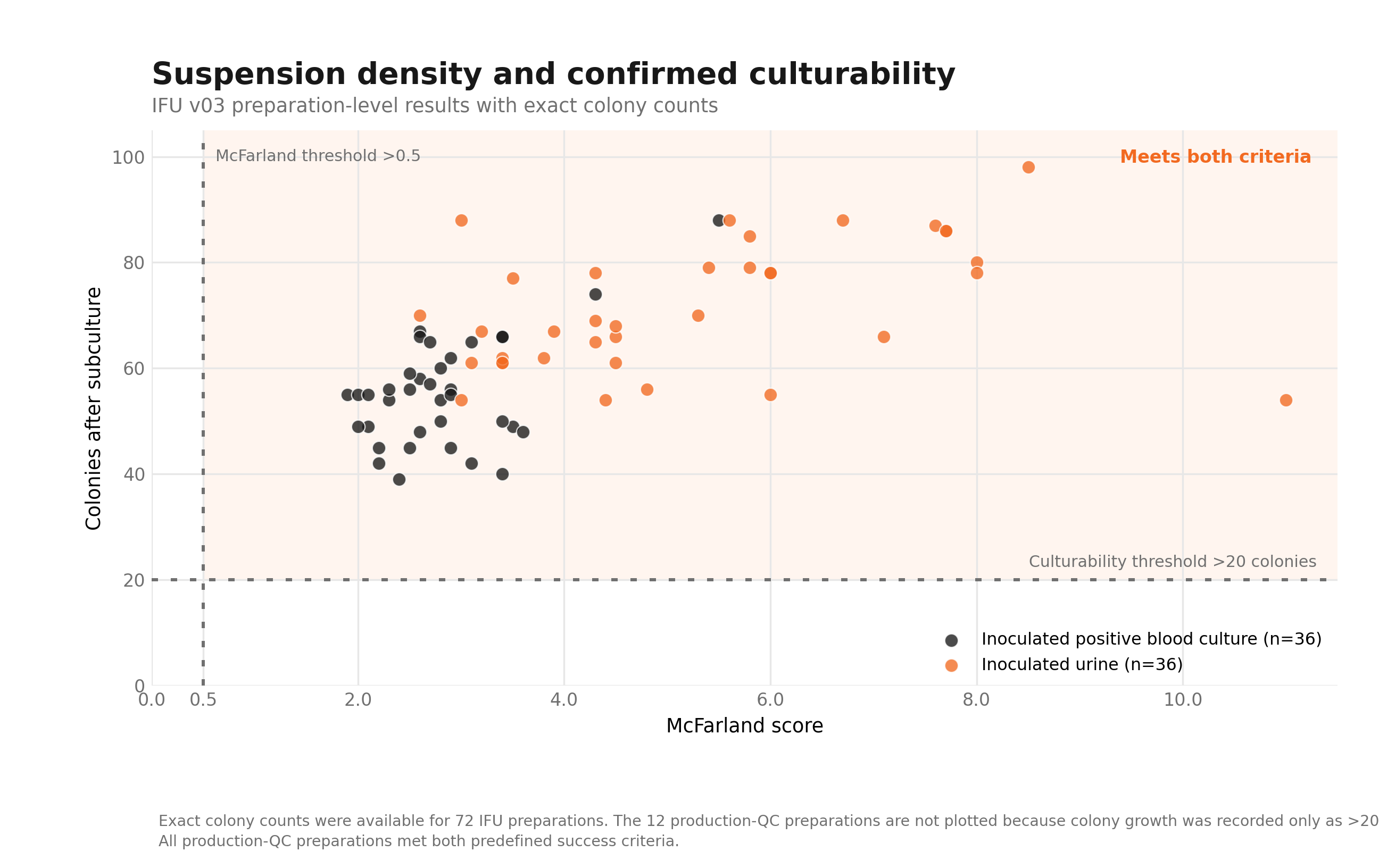
Legend: McF = McFarland. Successful preparation = McFarland >0.5 and growth of >20 colonies after subculture.
| Source | Sample matrix | Evaluated preparations | McF >0.5 | Mean McF | McF range | >20 colonies | Overall success |
|---|---|---|---|---|---|---|---|
| IFU v03 | Inoculated blood culture | 36 | 36/36 (100%) | 2.82 | 1.90-5.50 | 36/36 (100%) | 36/36 (100%) |
| IFU v03 | Inoculated urine | 36 | 36/36 (100%) | 5.28 | 2.60-11.00 | 36/36 (100%) | 36/36 (100%) |
| Production QC | Inoculated urine | 12 | 12/12 (100%) | 2.13 | 1.80-2.50 | 12/12 (100%) | 12/12 (100%) |
| Current combined dataset | All included matrices | 84 | 84/84 (100%) | 3.78 | 1.80-11.00 | 84/84 (100%) | 84/84 (100%) |
Result: 84 of 84 evaluated preparations achieved sufficient suspension density and confirmed culturability.
Interpretation: The combined mean McFarland pools different sample matrices and is provided descriptively. It is not the primary performance endpoint. Preparation success is determined by whether each preparation meets both predefined criteria.
* Based on 72 IFU evaluations using 36 strains representing 18 species in inoculated blood-culture and urine models, together with 12 production QC evaluations using urine inoculated with E. coli ATCC 25922 across four QUICKprep lots. A successful preparation was predefined as a recovered suspension measuring >0.5 McFarland and producing >20 colonies after subculture. FASTINOV data on file.
Supporting downstream evidence - not included in the primary endpoint
Published studies show that microbial preparations obtained using QUICKprep or the FASTINOV preparation protocol can support compatible downstream identification and AST workflows. These outcomes are supporting evidence and are not included in the 84/84 primary preparation-success calculation.
Positive blood cultures - 364 clinical samples
142 of 155 clinical positive urine samples
Multisite validation - 670 positive blood cultures
Gram-negative / Gram-positive bacteria - 154 samples
Publications and studies
364 clinical positive blood cultures prepared using the FASTINOV protocol and analysed by MALDI-TOF MS. Overall identification agreement was 95.6%, with no misidentifications reported.
Cruz S, Abreu D, Gomes R, et al. Eur J Clin Microbiol Infect Dis. 2024;43:605 610.
Read the PubMed recordIn clinical positive urine samples, 142 of 155 were identified by direct MALDI-TOF MS after QUICKprep preparation. The reported direct-identification workflow took approximately 15 minutes.
Sousa-Pinheiro M, Martins-Oliveira I, Abreu D, et al. Eur J Clin Microbiol Infect Dis. Published online 2026.
Read the PubMed recordA proof-of-concept study evaluated 154 inoculated urine samples using FASTgramneg and FASTgrampos flow-cytometry panels, with results interpreted according to EUCAST criteria.
Sousa-Pinheiro M, Martins-Oliveira I, Abreu D, et al. Microorganisms. 2026;14(3):711.
Read the full articleA three-site validation of 670 positive blood cultures reported sensitivity and specificity above 95% for every antimicrobial evaluated.
Pina-Vaz C, Silva-Dias A, Martins-Oliveira I, et al. BMC Microbiol. 2024;24:187.
Read the PubMed recordData on file
The current preparation-success calculation combines 72 preparation evaluations reported in QUICKprep IFU v03 and 12 production quality-control evaluations performed in 2026.
Published downstream identification and AST outcomes are not included in the primary preparation-success calculation. Additional direct preparation studies may be added when preparation-level McFarland and culturability results are available.
* Based on 72 IFU evaluations using 36 strains representing 18 species in inoculated blood-culture and urine models, together with 12 production QC evaluations using urine inoculated with E. coli ATCC 25922 across four QUICKprep lots. A successful preparation was predefined as a recovered suspension measuring >0.5 McFarland and producing >20 colonies after subculture. FASTINOV data on file.
References